Ace4 2026
From RAG to Case Intelligence: Why Simple Vector Retrieval Fails in Complex Litigation
From RAG to Case Intelligence: Why Simple Vector Retrieval Fails in Complex Litigation
ACE4 moves legal teams beyond document retrieval into a connected case-intelligence workflow across workflows, evidence, chronology, and attorney-ready outputs.
Retrieval-Augmented Generation (RAG) has become the default architecture for enterprise AI. It works well for many document search and Q&A applications, but litigation is different. In legal work, the objective is not just to find relevant text; it is to reconstruct the facts, timeline, relationships, and evidence that drive a case.
$$\text{Documents} \rightarrow \text{Chunking} \rightarrow \text{Embeddings} \rightarrow \text{Vector Store} \rightarrow \text{Retrieval} \rightarrow \text{LLM} \rightarrow \text{Response}$$
For many business use cases, this architecture is enough. Complex litigation exposes its limitations.
While building Ace4 AI—an enterprise AI litigation intelligence platform—we identified a core design challenge: retrieving semantically similar text is not the same as reconstructing a case.
A litigation matter is not simply a collection of documents. It is a living network of facts, events, people, communications, claims, defenses, witnesses, and evidence that evolves over time. RAG is an important building block, but it is not the complete legal intelligence architecture.
1. The Chunk Is Often the Wrong Unit of Litigation Intelligence
Most RAG pipelines begin by splitting documents into chunks. Each chunk is converted into an embedding and stored in a vector database. For a query $q$, retrieval typically ranks candidate chunks according to similarity between the query embedding and document embeddings:
$$\text{Similarity}(q, d_i) = \text{cosine}(E(q), E(d_i))$$
This works when the answer exists within a small number of semantically related passages. Litigation questions frequently violate that assumption. Consider:
"When did the defendant first become aware of the alleged contractual breach?"
The answer may require information from:
- An email written in January
- Meeting minutes from February
- An internal memorandum from March
- A contract amendment
- A witness interview
- Deposition testimony taken two years later
No individual chunk necessarily contains the answer. The answer exists in the relationships among those sources.
| Architectural Approach | Core Question | Focus Area |
|---|---|---|
| Document Retrieval (Standard RAG) | "Which passages are relevant to this query?" | Isolated text similarity |
| Ace4 Case Intelligence | "Which evidence, events, people, and relationships collectively establish or challenge this factual proposition?" | Multi-source relationship graphs |
2. Semantic Similarity Does Not Equal Evidentiary Importance
Vector retrieval optimizes semantic similarity. Litigation analysis often requires a different ranking function. A document may have low semantic similarity to a query while having high evidentiary significance.
In litigation, a retrieval model cannot rely on semantic similarity alone. The better approach is to score each document across several factors at once:
$$R(d) = \alpha S + \beta T + \gamma E + \delta I + \epsilon P + \zeta C$$
Where S = semantic relevance, T = temporal relevance, E = evidentiary significance, I = issue relevance, P = person/entity relevance, and C = corroboration or contradiction value.
3. Litigation Requires Temporal Reasoning
Dates are fundamental to litigation, but dates themselves have different meanings across case records.
| Creation Date | Event Date | Effective Date | Execution Date |
| Communication Date | Filing Date | Modified Date | Referenced Historical Date |
A litigation architecture requires temporal normalization into structured events:
{
  "event_id": "EVT-8942",
  "event_date": "2024-01-08",
  "date_type": "referenced_historical",
  "date_confidence": 0.95,
  "description": "Discussion regarding system vulnerability",
  "participants": ["Person::Bob_Smith", "Person::Jane_Doe"],
  "source_documents": ["DOC-1049_Email_March15.pdf"],
  "related_issues": ["Issue::Pre_Transaction_Knowledge"],
  "evidence_strength": "high"
}
4. Entity Resolution Becomes a Case-Level Requirement
Names vary wildly across litigation records. A single individual may appear as Robert J. Smith, Robert Smith, Bob Smith, R. Smith, CEO, Chief Executive Officer, or simply "Bob." Companies create similar problems through subsidiaries, former names, abbreviations, departments, and corporate entities.
If the system fails to resolve these references, case understanding fragments. Entity resolution must link real-world entities to explicit relationships:
5. Cross-Document Relationships Matter More Than Individual Documents
Imagine four pieces of evidence:
- Document A: An executive states no decision has been made.
- Document B: Meeting minutes from the previous week record approval of the decision.
- Document C: A later email says implementation has already started.
- Deposition Testimony: The executive states that approval occurred after Document A.
A standard RAG system can retrieve all four documents independently. The true litigation value, however, comes from explicitly mapping their structural relationships:
6. Litigation AI Benefits From an Evidence Graph
One approach is to represent the matter as a graph rather than relying entirely on vector embeddings. Combining semantic vector search with structural graph traversal enables richer inquiry:
- Vector Search Answers: "What information resembles my question?"
- Graph Traversal Answers: "What other evidence is connected to this event, witness, issue, or factual proposition?"
7. Contradiction Detection Requires Pairwise and Multi-Source Analysis
Traditional RAG tries to retrieve supporting context; litigation often requires actively searching for conflicting context.
FACTUAL PROPOSITION EXTRACTION
├─ P1: "The contract was approved on March 4."
├─ P2: "The contract was approved on March 18."
└─ P3: "Approval had not occurred as of March 10."
                  │
                  ▼
CONTRADICTION ANALYSIS PIPELINE
Source ──> Fact Extraction ──> Entity Resolution
       ──> Event Alignment ──> Proposition Comparison
       ──> Contradiction Detection
                  │
                  ▼
ACE4 CONTRADICTION MATRIX & EVIDENCE MAP
The engine must classify findings into distinct status buckets:
- Corroboration
- Direct Contradiction
- Partial Contradiction
- Temporal Inconsistency
- Different Interpretations
- Insufficient Evidence
Falsely declaring a contradiction can be as problematic as missing one.
8. Provenance Cannot Be Added at the End
Legal AI requires absolute traceability. An attorney cannot rely on an unverified summary for deposition preparation or motion practice. Provenance must be maintained through a continuous, end-to-end chain:
$$\text{Proposition} \rightarrow \text{Event} \rightarrow \text{Supporting Facts} \rightarrow \text{Sources} \rightarrow \text{Passages} \rightarrow \text{Page/Para} \rightarrow \text{Metadata} \rightarrow \text{Confidence}$$
Provenance is not a post-hoc citation step performed after the LLM generates an answer—at Ace4 AI, explainable AI and source-linked evidence mapping exist natively across ingestion, extraction, relationship mapping, retrieval, and reasoning.
9. Context Windows Do Not Solve Case Understanding
Providing 500 pages of raw text inside a million-token context window does not teach the model which facts represent:
- The same event vs. different events
- Contradictory accounts vs. independent corroboration
- Original evidence vs. duplicate filings
Large-context models process more text, but they do not structure information. Effective case intelligence requires assembling task-specific context layers:
Context Engineering Spectrum: Query Context → Document Context → Entity Context → Temporal Context → Issue Context → Witness Context → Evidence Context → Case Context
10. Different Litigation Tasks Require Different Retrieval Strategies
1. Identify Task & Workflow
   └─ Select operational workflow (Document chat, chronology, deposition prep, discovery).

2. Select Retrieval Strategy
   ├─ Case Chronology: Temporal extraction and event clustering
   ├─ Witness Intelligence: Entity-centric graph traversal & Witness Matrix
   ├─ Deposition Preparation: Witness profiles + issue + contradiction context
   └─ Master Case Index: Legal significance scoring, hot document lists, gap analysis

3. Execute Multi-Modal Retrieval
   └─ Combine Vector, Keyword, Metadata, Temporal, Entity, and Graph queries.

4. Evidence Assembly & Reasoning
   └─ Assemble structured context and execute agentic reasoning to produce verified work product.
11. The Ace4 AI Litigation Architecture
Moving away from a vector database as the center of the system yields the multi-layered Ace4 AI Case Intelligence architecture:
                  ┌─────────────────────────┐
                  │     Raw Case Files      │
                  │ (Docs, Transcripts,     │
                  │  Emails, Audio/Video)   │
                  └────────────┬────────────┘
                               │
                  ┌────────────▼────────────┐
                  │ Parsing + OCR + Transc. │
                  └────────────┬────────────┘
                               │
                  ┌────────────▼────────────┐
                  │ Document Classification │
                  └────────────┬────────────┘
                               │
                  ┌────────────▼────────────┐
                  │  Chunking & Embeddings  │
                  └────────────┬────────────┘
                               │
                  ┌────────────▼────────────┐
                  │ Structured Legal Facts  │
                  └────────────┬────────────┘
                               │
                  ┌────────────▼────────────┐
                  │    Entity Resolution    │
                  └────────────┬────────────┘
                               │
                  ┌────────────▼────────────┐
                  │ Temporal Normalization  │
                  └────────────┬────────────┘
                               │
                  ┌────────────▼────────────┐
                  │    Event Extraction     │
                  └────────────┬────────────┘
                               │
                  ┌────────────▼────────────┐
                  │ Relationship Mapping    │
                  └────────────┬────────────┘
                               │
                  ┌────────────▼────────────┐
                  │  CASE INTELLIGENCE LAYER│
                  └────────────┬────────────┘
                               │
                  ┌────────────▼────────────┐
                  │    Hybrid Retrieval     │
                  │ Vector + Keyword + Meta │
                  │ Temporal + Entity + Graph│
                  └────────────┬────────────┘
                               │
                  ┌────────────▼────────────┐
                  │  Ace4 Task-Specific     │
                  │      AI Agents          │
                  └────────────┬────────────┘
                               │
┌─────────────────┬──────────────┼───────────────┬────────────────┐
│                 │              │               │                │
▼                 ▼              ▼               ▼                ▼
Chronology   Case Index    Discovery Prep  Witness Intel   Depo Preparation
│                 │              │               │                │
└─────────────────┴──────────────┼───────────────┴────────────────┘
                               │
                  ┌────────────▼────────────┐
                  │ Evidence-Grounded       │
                  │ Attorney Work Product   │
                  └─────────────────────────┘
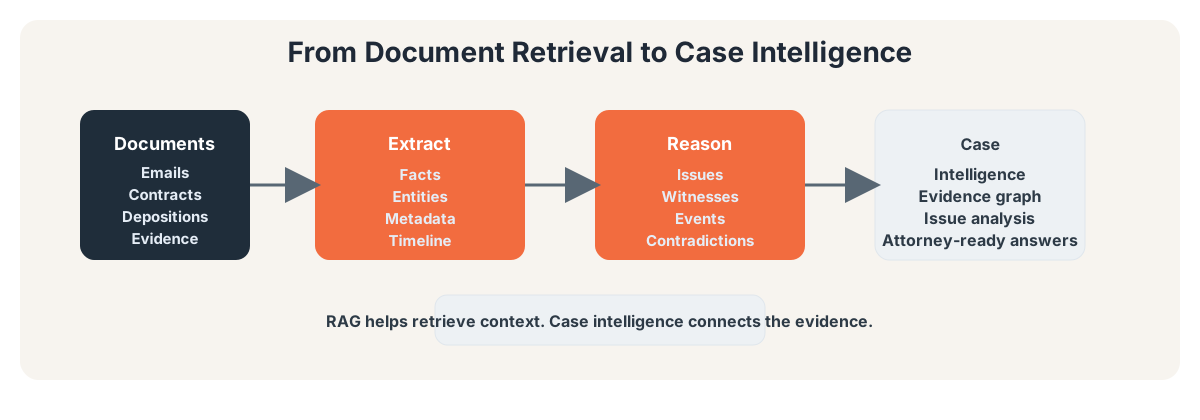
From RAG to Case Intelligence
The architectural shift powering Ace4 AI comes down to progression across six distinct capabilities:
$$\text{Retrieving Documents} \rightarrow \text{Identifying Facts} \rightarrow \text{Reconstructing Events} \rightarrow \text{Connecting Evidence} \rightarrow \text{Supporting Workflows}$$
To deliver real legal value, teams need to combine semantic retrieval with structured extraction, entity resolution, temporal reasoning, relationship mapping, contradiction analysis, evidence provenance, hybrid retrieval, and agentic AI orchestration.
RAG is necessary for legal AI, but for complex litigation it is not sufficient. This is why Ace4 AI was built: to create an evidence-grounded view of the entire matter, helping legal teams reason across documents, events, witnesses, issues, and time with greater confidence.